
The Ultimate Cat Litter Box Enclosure Guide
Hiding the litter box shouldn’t cost you the room it sits in. Types, sizing, materials, odor, multi-cat setups: here’s what actually changes the outcome when you shop for a cat litter box enclosure, and where the cheap ones give up.
In This Guide
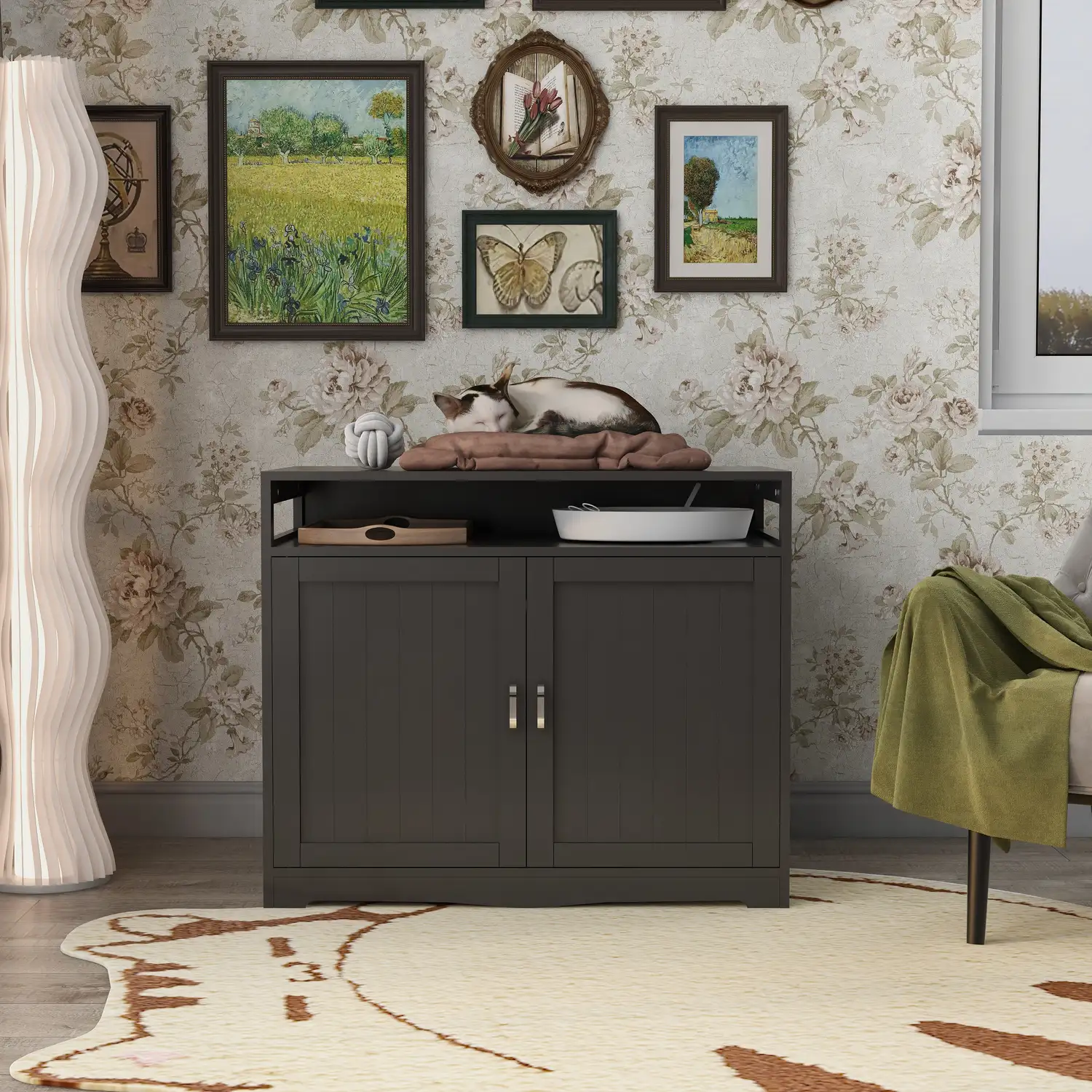
Why It’s Worth Hiding the Box
Most cat parents start with a basic plastic tray, and it works fine until you notice three things at once: the box is the first thing guests see, litter tracks halfway across the floor, and the smell announces itself from the hallway. A cabinet that holds the tray inside real furniture handles the first two directly, and it gives your cat an enclosed spot that feels calmer than an open pan in a room where people keep walking past.
Worth saying up front: a cabinet is a containment and styling fix, not a behavior fix. If your cat has already started going outside the box, the litter type, the location, and a vet visit come before new furniture. No cabinet solves that one.
What Is a Cat Litter Box Enclosure?
A cat litter box enclosure is a cabinet, bench, or side table with a hidden compartment sized for a standard litter pan. Your cat goes in through a front door, a side opening, or a flap. From the outside it reads as an entryway console, a bedroom bench, or a living-room end table, so the litter station stops being the thing your eye lands on first.
The category sits inside a broader idea called catification, which comes down to designing around what a cat needs without making your place look like a boarding facility. A hidden litter cabinet is usually where people start, since it changes the look of a room more than anything else you can buy for a cat.
The Main Types, and Who They Suit
1. Hidden Cabinet Enclosures
These look like a sideboard or a nightstand with a door on the front or the side, which is why they hold up in living rooms and bedrooms. A sisal-wrapped door gives your cat something to scratch on the way out, and plenty of cats take that offer. A plain panel door is quieter visually, worth choosing if the cabinet is landing somewhere prominent like beside the TV.
2. Dual-Entry Cabinets
A second opening on the side or back gives a nervous cat an exit route and moves more air through the compartment. Two paths cut down the cornered feeling, and some cats that stalled on a single-door cabinet settle into a dual-entry one within a week. The trade-off is placement, since you need clearance on two sides, so wedging one into a tight alcove undoes the reason you bought it.
3. Corner and Tower Styles
Corner units take the triangle of floor nobody uses, which counts for a lot in a studio or a small one-bedroom. Tower and storage-cabinet styles stack shelves above the litter area for the scoop, liners, and a spare bag of litter. A combined cat tree and storage cabinet can stand in for two separate pieces when there isn’t room for both.
4. Bench and Entryway Consoles
These live in a hallway or by the door with a flat top for keys, mail, or a lamp, and apartments favor them because the footprint does two jobs at once. Think twice about the entry spot if that’s also where you set down groceries, because litter dust and food bags a foot apart bothers most people eventually.
| Type | Works for | Space need | Typical look |
|---|---|---|---|
| Hidden cabinet | Living room or bedroom | Medium | Sideboard / nightstand |
| Dual-entry cabinet | Anxious or shy cats | Medium | Sideboard with side door |
| Corner unit | Small apartments | Low footprint | Wedge cabinet |
| Bench / console | Entryway or hallway | Medium | Console table |
How to Size One Correctly
Sizing is the step most buyers get wrong. Measure the pan you already own, then compare it to the cabinet’s inner compartment rather than the outer dimensions, which include panel thickness and whatever shelf sits above. The pan should drop in with room left over for your cat to turn around and step in without folding itself in half.
The inner floor wants a few inches of slack past the pan in both directions, and the door opening needs to be tall enough that your cat isn’t crouching to get through. Senior cats and large breeds care about the step height more than the width.
- Small cats and kittens: a compact cabinet is fine, as long as the entry sits low.
- Average adult cats: aim for an inner area roughly 20″–22″ deep.
- Large cats, Maine Coon or Ragdoll: go wider, or plan on an extra-large pan that still clears the door.
Check the stated weight limit if your cat is going to nap on the top. When the listing doesn’t give a number, treat the surface as decorative and keep the heavy stuff off it.
Materials: What Actually Matters
Solid wood, engineered wood (MDF or particle board), or a mix of the two covers nearly everything on the market, and the choice drives durability and how the piece handles humidity more than the price tag does.
- Solid wood: durable and good-looking, also heavier and pricier.
- Engineered wood: stable and affordable; look for low-emission panels, TSCA Title VI compliant in the U.S., when the piece uses composite board.
- Finish: water-based paints and sealants are common on pieces built for homes with pets. Read the product page for what the coating actually is rather than assuming.
A matte or scratch-resistant coating keeps the piece presentable after months of use, and it matters most on the door your cat shoves through twice a day. Thin veneer is usually the first thing to lift, and edges take more abuse than flat panels do.
Odor Control and Ventilation
No cabinet removes odor on its own, so what you do daily counts for more than which model you picked. Choose one with ventilation gaps or a mesh panel, scoop a clumping litter every day, and a charcoal pad or a shallow tray of baking soda inside the compartment picks up part of the rest.
Don’t seal the compartment. An airtight box holds the ammonia smell in, which is unpleasant for you and for the cat that has to step inside. Passive airflow is the goal, so leave the vent side a little off the wall instead of pushing the cabinet flush against it.
Multi-Cat Homes: How Many Cabinets?
One box per cat plus one spare is the usual guideline, and it doesn’t translate to one cabinet per cat. Two pans in two enclosures in separate rooms works, and so does one cabinet per location with a single large pan inside. Cats tend to want a choice of places more than a choice of pans in the same corner.
Low-entry, easy-clean designs pay off most in a multi-cat home, since you’re scooping more often and a slide-out tray or a wide door saves real minutes over a month. Two pans crammed into one compartment is the setup that backfires: the second cat often quits on it, and you end up buying the extra cabinet anyway.
Assembly, Placement, and Daily Care
Most cabinets arrive flat-packed, so budget 20–40 minutes and a basic screwdriver. Build it on a rug or a blanket so the panels don’t get scratched against the floor, and confirm which way the door swings before you commit to a wall. Keep the unit away from food and water bowls, since cats prefer those areas separate.
Daily care runs to a scoop once a day and a wipe of the interior weekly. A handheld vacuum parked nearby deals with the litter that rides out on paws, which is the part no cabinet fully prevents.
Our Picks from OmniHaven
At OmniHaven we design these pieces as furniture first. The Cat Litter Box Enclosure with Sisal Door puts a hidden washroom behind a scratch-friendly door and gives you an end-table top. The Dual Entry Cat Litter Box Cabinet adds the second opening, which is the one to look at if your cat has bailed on a covered box before. The full range sits in our For Cat Lovers collection. If the only free spot in your place is a sealed closet with no airflow, neither cabinet is the right call, and an open pan with a litter mat is the more honest setup.
Frequently Asked Questions
Will my cat use a litter box enclosure?
Most cats settle in within a few days. Leave the door off or propped open at the start, set the old pan inside the compartment instead of buying a new one, and let your cat find it without any coaxing. If two weeks pass and your cat still won’t go in, keep the old open box in the room as a backup rather than forcing the switch, and try the cabinet again with the door removed.
Can a larger litter pan fit inside?
Depends on the model, and the door is what usually decides it, not the floor. High-sided pans eat into the opening height, so a pan that technically fits the compartment can still leave your cat squeezing past a lip. Top-entry pans don’t work inside a cabinet at all, since the cabinet already covers the top. Measure your pan’s height along with its length and width before you order.
Is an enclosure safe for kittens?
Yes, with a low entry and a little patience. A tall step-in discourages use while they’re small, and a kitten can slip into the gap behind or beside a pan that’s too small for the compartment, so fill the space or size the pan up. Take the flap off for the first few weeks. For broader kitten-care guidance, the ASPCA’s cat-care resources are a helpful reference.
Do enclosures control odor completely?
No product does that alone. What a cabinet reliably cuts is visible dust and scattered litter, which is a bigger daily annoyance than smell for a lot of households. The vent gaps only work if air can reach them, so a cabinet shoved flush into a corner will hold odor longer than the same cabinet pulled an inch off the wall.
What if my cat scratches the furniture?
Some enclosures include a sisal panel for exactly that, and a separate scratcher a few feet away redirects most of the habit. Corners and edges take the hits, not flat panels, so that’s where a scratch-resistant finish earns its money. Sisal wears down eventually; on a wrapped door you can re-wrap it with sisal rope instead of replacing the cabinet.
Trusted Cat Care Resources
A hidden cabinet is one of the easier upgrades in a house with cats. The tray disappears, the scatter stays in one place, and you get a usable surface back. Measure the inner compartment before you buy, read what the panels and finish actually are, and put the thing where you’ll really keep it rather than where it photographs well. Your cat gets a private corner, and your living room stops looking like a supply aisle. Browse the OmniHaven cat litter box enclosures.